
 There are a lot of different types of displays on the market, but two of the most popular are OLED and AMOLED. In this article, we compare the benefits of both displays to help you decide which one is better for your needs.
What Is an OLED Display?
An OLED (organic light-emitting diodes) display produces an array of OLED pixels that emit light when current is passed through them. This makes OLED displays thinner and more efficient, compared to traditional LCD displays. Additionally, OLED displays can be made transparent, flexible, foldable, and even rollable and stretchable in the future.
What Is an AMOLED Display?
An AMOLED (active-matrix organic light-emitting diode) is a display technology used in smartwatches, mobile devices, laptops, and televisions. AMOLED displays are made by placing a grid of thin-film transistors (TFTs) on top of an OLED film. AMOLED displays are typically brighter and contrast better than LCDs. They also consume less power, which can help to extend their battery life.
Difference Between AMOLED and OLED Displays
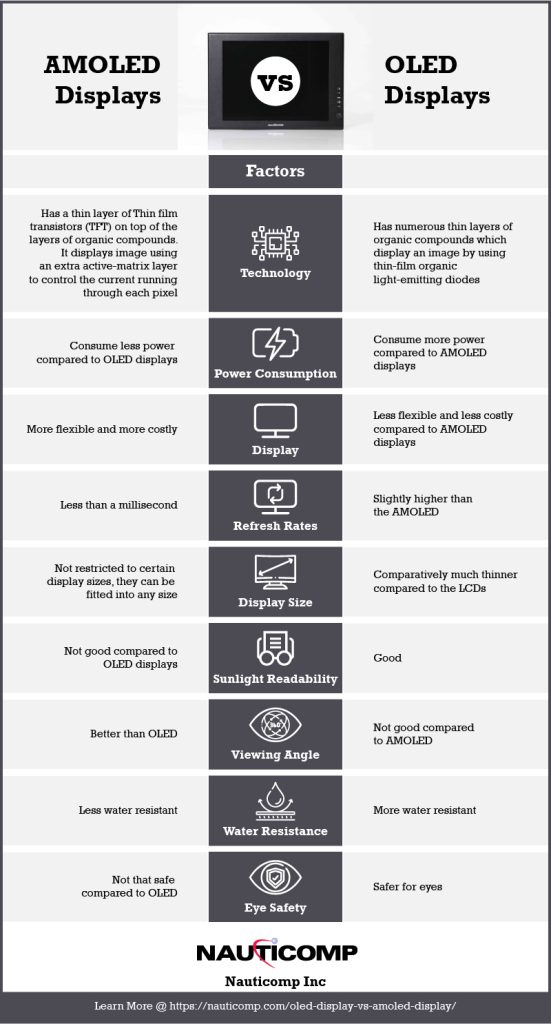
OLED and AMOLED displays are very similar, but there are a few key differences.
-
Technology Used:
The fundamental structure of OLED and AMOLED is different. OLED has numerous thin layers of organic compounds, whereas AMOLED includes a thin layer of transistors on top of the layers of organic compounds. OLEDs display an image by using thin-film organic light-emitting diodes, while AMOLED displays use an extra active-matrix layer to control the current running through each pixel.
-
Power Consumption:
AMOLED displays typically consume less power than OLED displays. This is due to the fact that each pixel in an AMOLED has its own transistor and capacitor, allowing for more efficient power usage. By using an AMOLED, the user saves money on device operating costs.
-
Display:
Unlike LCD panels which have a backlight that is always on, OLED displays are “off” by default unless each pixel is electrified. This enables much deeper blacks. AMOLED displays do not perform as well in direct sunlight when compared to other types of displays. The exceptional picture quality of AMOLED displays is due to the TFT backplane technology.
-
Contrast Ratio:
The contrast ratio of an OLED display is excellent since it has a high degree of pixel control. AMOLEDs have faster refresh rates than regular OLEDs, providing a great artificial contrast ratio. This is because each pixel on an AMOLED display emits light, resulting in a crisper image.
-
Sunlight Readability:
AMOLED displays cannot be read as quickly in direct sunlight when compared to LCDs and OLEDs.
-
Viewing Angle:
The viewing angle of an AMOLED display is slightly better than that of an OLED display.
-
Display Size:
Both OLED and AMOLED provide more efficient and bright displays as these are comparatively thinner compared to the LCDs. AMOLED displays are not restricted to certain display sizes like OLEDs, so they can be fitted into any size. AMOLED panels, on the other hand, can support any display size and can produce a faster refresh rate even at a large size.
-
Display Cost:
AMOLED displays are more expensive to manufacture compared to OLED displays.
-
Water Resistance:
OLED panels are more water resistant since there is no risk of damaging the backlight.
-
Eye Safety:
Because OLED panels do not use a backlight, they are considered to be safer for your eyes compared to AMOLEDs.
Which Display Is Better for You?
Now that we know the key differences between OLED and AMOLED displays, it’s time to decide which one is better for you.
While both OLED and AMOLED technologies have many similarities, AMOLED has several significant advantages over its OLED counterpart. Many of the top smartphone companies use AMOLEDs in their products because they are more flexible than other types of OLED devices. While AMOLED devices cost more to produce than OLED displays, but the image quality is generally better, and they consume less power.
That said, if you’re looking to buy a monitor that will last you longer, an OLED display would be a better choice since it won’t wear down as quickly.
Both OLED and AMOLED displays have their unique advantages and disadvantages. It really depends on your needs as to which display is better for you.
Contact Nauticomp Inc. for AMOLED and OLED Displays
Nauticomp Inc. provides world-class fully customizable touchscreen displays for commercial and industrial settings. With features like sunlight readability, brightness adjustability, infrared lighting, full backlighting, all-weather capabilities, etc., our displays are second to none. Contact us today to learn more.Â
 Touchscreen displays are becoming more and more common in both personal and business settings. They offer a level of convenience and interactivity that is hard to beat. However, touchscreen displays can be fragile and are susceptible to damage from drops or scratches.